
10 Easy Ways to Make Your Home a Bilingual Haven
When my daughter was little, I used to worry: “We only speak Chinese for part of the day—how will she ever feel Mandarin is natural?” Living in an English-dominant country means our kids are surrounded by English everywhere—school, playground, even the cereal box.
But at home, we can create something special: a bilingual home where Mandarin is part of daily routines. You don’t need fancy resources or a classroom setup—just a few simple systems that make Chinese visible and enjoyable. Here are 10 easy, real-life ways we’ve turned our house into a bilingual haven.
1. Label Everyday Items in Your Bilingual Home
Our fridge has a label that says “冰箱 (bīng xiāng)”. The toy zone says “玩具 (wán jù)”. The light switch says “开关 (kāi guān). These little sticky notes remind my kids that Chinese is part of their daily world. Bonus: they often point at the word and try to read it themselves!
2. Create a Print-Rich Bilingual Environment at Home
We keep Chinese picture books on low shelves, a Chinese calendar on the coffee table, and even print out my daughter’s daily routine in Chinese to tape on the wall. When the text is always in sight, kids absorb it naturally.
3. Use Bilingual Labels for Toy Organisation
Sorting toys into a box or bag labeled in Simplified Chinese+Pinyin+English, such as “积木 (jī mù) blocks”, “拼图 (pīn tú) puzzles”, “桌游(zhuō yóu) board games” , not only keeps the mess under control but also builds word recognition. My little one loves reminding us to “put LEGO back in the 积木 box.”
4. Rotate Chinese Books to Keep Your Bilingual Home Fresh
Instead of leaving all our books out at once, I rotate them every few weeks. This keeps the bookshelf fresh and helps kids rediscover old favourites—like 《我的爸爸》 (My Dad) and 《我的妈妈》 (My Mum) by Anthony Browne.
5. Use a Family Message Board in Chinese
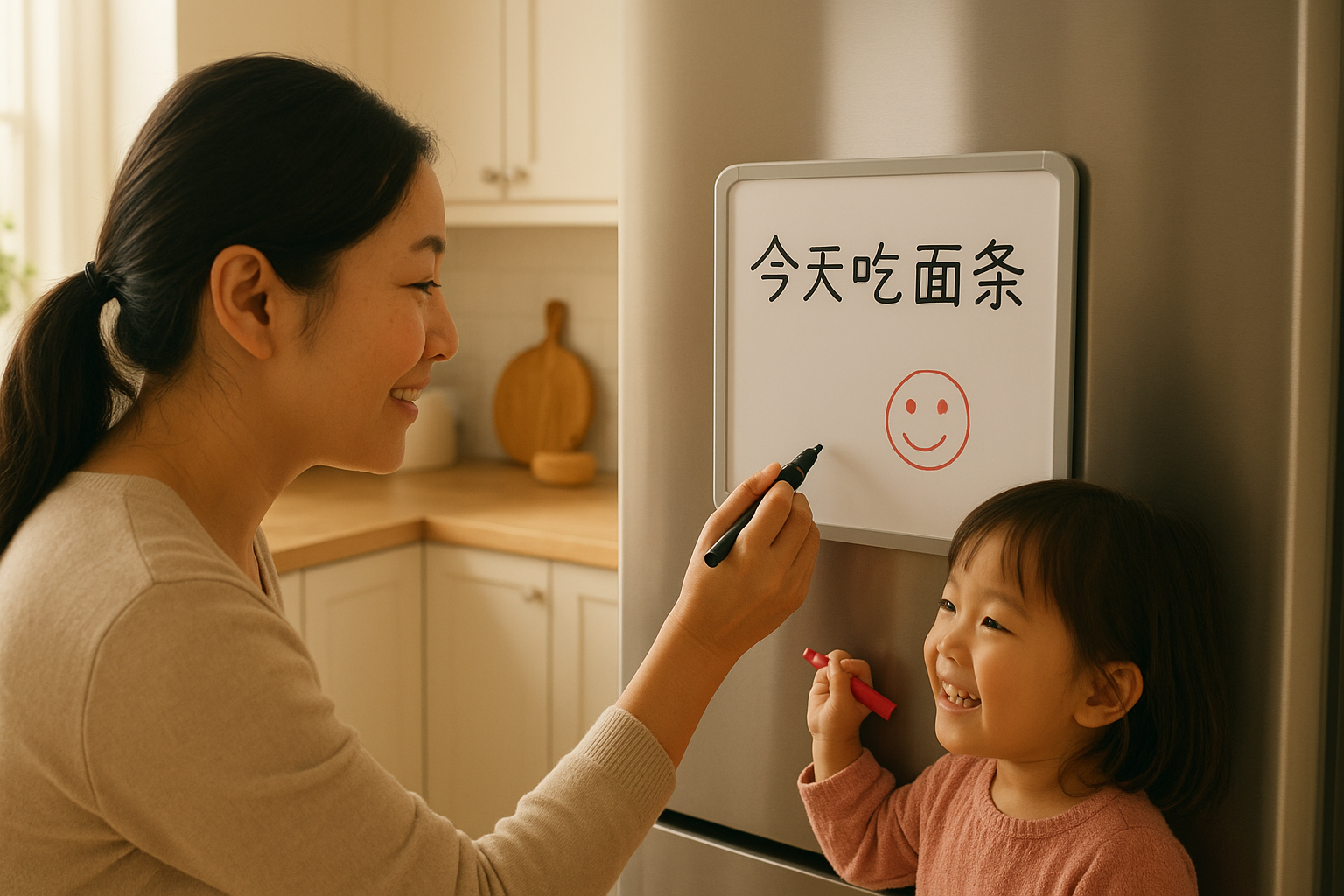
We have a small magnetic whiteboard on the fridge door where we write simple notes in Chinese: “今天吃面条” (Today we’re eating noodles). My daughter loves leaving us notes back, even if it’s just one emoji.
6. Add Chinese Music and Story to Daily Routines
Background music matters! In the morning, I like to play Chinese nursery songs while preparing breakfast. Sometimes, we switch to a kid-friendly Mandarin story during breakfast. It creates natural exposure without “study time.”
7. Celebrate and Decorate for a Bilingual Home
During Chinese New Year festivals, we put up Chinese traditional decoration. But I’ve found that even outside festivals, a simple “家 (jiā)” sign in the living room makes kids feel proud of their bilingual identity.
8. Involve Kids in Chinese Grocery Lists
I made mini Chinese ingredients labels with icons – like 米 (rice), 鸡蛋 (eggs), 西红柿 (tomatoes)—so that my daughter can create a shopping list with me together even if she can’t fully read or write yet. The labels are reusable. It turns errands into fun language practice and keeps Mandarin present in real life.
9. Create Photo Albums with Chinese Captions
We printed a family photo book, but I added Chinese captions: “在公园” (at the park), “生日快乐” (happy birthday). My kids love flipping through and asking about the words.
10. Make Chinese Part of Play at Home
When we play pretend grocery store, we use Chinese price tags and food names. When we build LEGO houses, we add signs that say “学校 (school)” or “家 (home)”. Play is the best classroom.
Key Takeaways For Bilingual Home
- A bilingual home doesn’t need to be perfect—small, consistent steps make a big difference.
- Labels, music, and print-rich spaces keep Mandarin visible in daily routines.
- Play and family moments are the most natural places for kids to grow their Chinese skills.
Try It Next
Want to get started today? Download my free printable Chinese labels pack and take the first step in turning your home into a bilingual haven.
