
Raising a Talkative Bilingual: Encouraging Mandarin Conversations at Home
Have you ever asked your child a question in Mandarin, only to hear them reply in English? Or maybe they answer with one word in Chinese before switching back. This is a familiar experience for many bilingual families. The good news is: by using useful Chinese phrases for parents in daily routines, you can encourage more natural Mandarin conversations at home. With gentle strategies, raising a bilingual child becomes less about drills and more about connection, play, and joy.
Why Encouraging Mandarin Conversations at Home Matters
Language thrives in connection. While flashcards and apps have their place, children build confidence to speak when Mandarin is part of family relationships.
Every small exchange—whether it’s asking for water, sharing a joke, or saying goodnight—helps your child:
- Strengthen vocabulary and sentence patterns in a meaningful way.
- Develop confidence in using Mandarin outside of “study time.”
- Connect Mandarin with warmth, love, and everyday family life.
When kids see Mandarin as a language of play and connection (not just rules or corrections), they are more willing to talk—and keep talking.
6 Gentle Strategies to Encourage Real-Life Mandarin with Kids
1. Create Low-Pressure Speaking Moments

Instead of asking, “Say this in Mandarin,” focus on playful and natural opportunities. For example:
- Yes/no questions: “你想出去玩吗?” (Do you want to play outside?)
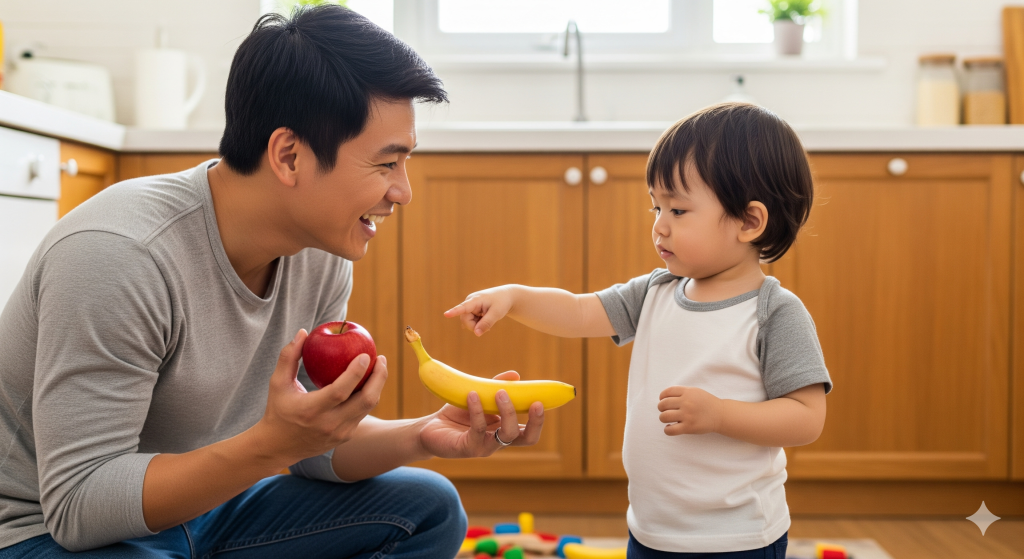
- Choice questions: “你要苹果还是香蕉?” (Do you want an apple or a banana?)
These easy prompts let kids answer without pressure, while still practicing Mandarin.
2. Model, Don’t Correct

If your child answers in English, try repeating back in Mandarin instead of correcting.
Child: “I want water.”
Parent: “好,我们去倒水。” (Okay, let’s get some water.)
This way, they hear the Mandarin equivalent without feeling judged, which encourages them to try next time.
3. Eight Useful Chinese Phrases for Parents to Spark Daily Talk
Children learn best from repeated exposure. By sprinkling in useful Chinese phrases for parents—short, warm sentences you can use every day—you normalize Mandarin in the home.

Here are 8 simple phrases to start with:
- “今天你过得开心吗?”(jīn tiān nǐ guò de kāi xīn ma?) – Did you have fun today?
- “快来吃饭吧!” (kuài lái chī fàn ba!) – Come eat!
- “注意安全哦!” (zhù yì ān quán ó!) – Be careful!
- “晚安,好梦。” (wǎn’ān, hǎo mèng.) –Goodnight, sweet dreams.
- “加油,你可以做到的!” (jiā yóu, nǐ kě yǐ zuò dào de!) – You can do it!
- “我们走吧。” (wǒ men zǒu ba) – Let’s go.
- “要不要一起玩(积木/过家家。。。)?” (yào bù yào yì qǐ wán (jī mù / guò jiāj iā…)?) – Do you want to play (blocks/pretend play…)?
- “谢谢宝贝,你真是我的小帮手。” (xiè xiè bǎo bèi, nǐ zhēn shì wǒ de xiǎo bāng shǒu.) – Thank you, sweetheart, you’re such a good helper.
Routine phrases stick quickly because they are tied to real-life Mandarin with kids—everyday actions, emotions, and connections.
4. Make Conversations Playful
Kids love games, and games are powerful for real-life Mandarin with kids.
Try the following ideas:
- Role-play shops: Take turns being the cashier and customer in Mandarin. For example:
“这个一共多少钱?(zhè gè yī gòng duō shǎo qián ?) – How much in all?” - Guessing games: The Chinese version of the “I Spy” game, often called “我看到了” (wǒ kàn dào le). For example:
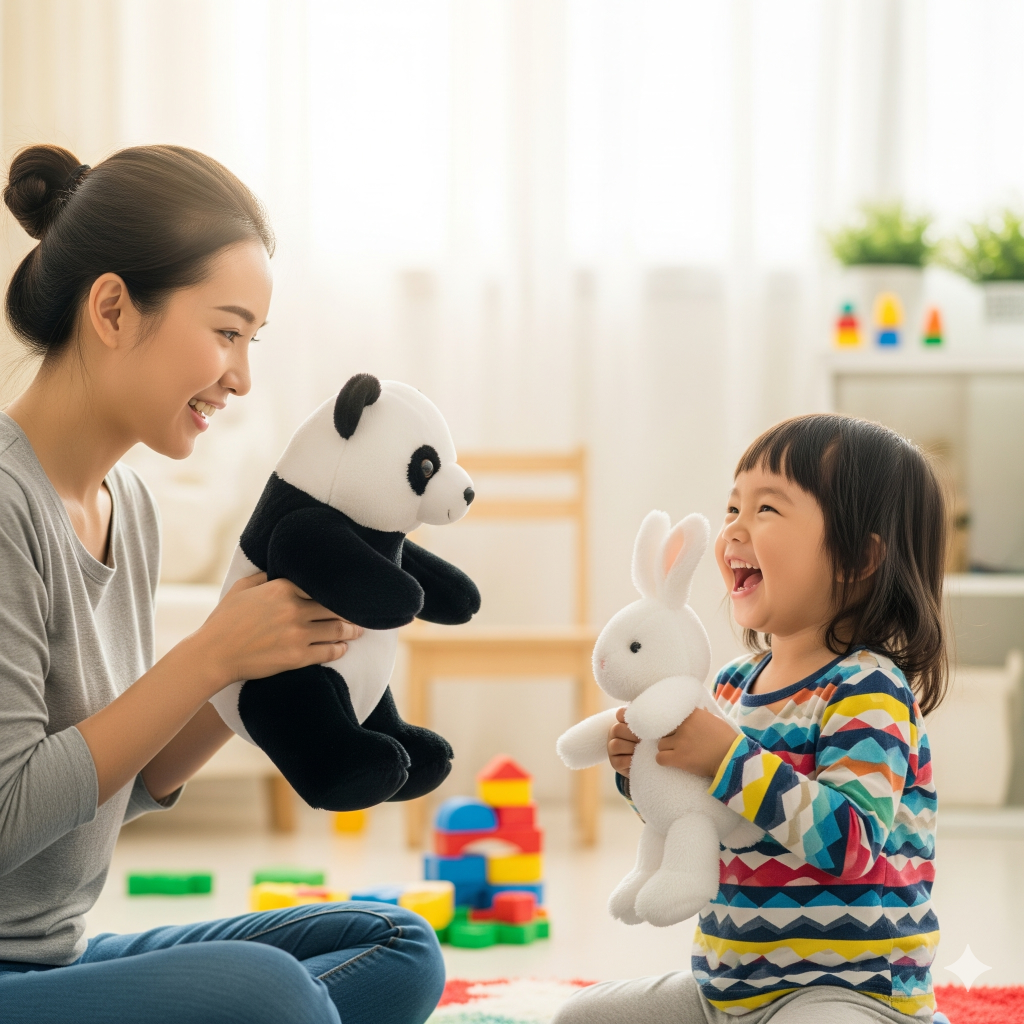
我看见一个红色的东西…(wǒ kàn jiàn yī gè hóng sè de dōng xī) – I see something red… - Mini Theater Role-Play: Let Toys Talk in Mandarin.For example: use your kids’ favourite stuffed toys. Parent (Panda toy): “Hello, Rabbit! Do you want to eat dumplings with me?” Child (Rabbit toy): “Yes! But I want ice cream too!”
keep it short, silly, and repetitive. Even if the child answers in English, the parent can repeat back in Mandarin,
so they get input without pressure. In short, play reduces performance pressure and makes speaking fun.
5. Celebrate Effort, Not Just Accuracy
When your child tries to speak Mandarin—even if tones or grammar aren’t perfect—praise the attempt.

For example:
- “哇,你今天尝试说中文了,真棒!(wā, nǐ jīn tiān cháng shì shuō zhōng wén le, zhēn bàng !)” – Wow, you tried speaking Mandarin today, that’s awesome!
- “你愿意说中文,真勇敢!(nǐ yuàn yì shuō zhōng wén, zhēn yǒng gǎn !)” -You were brave to use Mandarin—amazing!
This builds confidence and helps children connect positive encouragement with Mandarin, which motivates them to keep speaking more Mandarin.
6. Involve the Whole Family
Kids are more likely to speak if they see everyone engaging in Mandarin. Invite siblings, grandparents, or even playdates into the conversation. For non-native parents, simple participation—using labels, songs, or short phrases—shows that Mandarin belongs to the whole family, not just the child.
Key Takeaways for Raising a Bilingual Child
- Raising a talkative bilingual means making Mandarin part of daily connection, not just lessons.
- Use real-life Mandarin with kids through routines, play, and gentle prompts.
- Keep interaction positive: model language, celebrate effort, and avoid pressure.
- Your warmth and consistency matter more than perfect fluency.
When Mandarin is connected with love, laughter, and family life, children want to keep talking—and that’s how bilingual voices grow.
Try This Next
- Download our Free Mandarin Home Labels to spark real-life conversations around the house.
- Explore the Mandarin Supermarket Toolkit for role-play activities that get kids speaking.
- Read our post on Say It With Love: Gentle Parenting and Mandarin Learning to see how connection supports language growth.
- Want to keep your child motivated? Check out our Daily Mandarin Boost – Printable Encouragement Stickers & Toolkit for Kids. These colorful stickers and toolkit help kids feel proud of their Mandarin progress every single day. Or try a few free sample stickers from this toolkit with your child right away!
